Categories
Analysis and views op-eds

France shows social leasing is the way forward

Op-ed co-signed with Sebastian Mang published in Euractiv.com.

Energy has been the main driver of Europe’s biggest inflation crises – the 1973 oil shock, the 2022 gas crisis, the price surge we are all witnessing today. Each one is triggered by volatile global fossil fuel markets, each driving up household bills and resulting in massive profits for fossil fuel companies.  

As European governments look for answers to the painful effects of high energy prices for consumers and businesses, the temptation is to soften the blow to consumers with tax cuts on energy and other costly emergency measures. This was the strategy followed in 2022-23, resulting in €540bn being spent to relieve the pain. Government debt rose, in many cases simply to subsidise the very fossil fuels that had caused the inflation pain in the first place. Meanwhile, our efforts to move away from fossil fuels have been slow and poorly designed, prompting public cynicism towards the green transition. 

The EU can do better to support people while also making our economy more resilient. A bright spark in an otherwise uninspiring policy landscape has been the rise of social leasing programmes for green tech. Such programmes are some of the very few ways that governments have been helping ordinary households access the benefits of the transition and permanently reduce fossil fuel demand.  

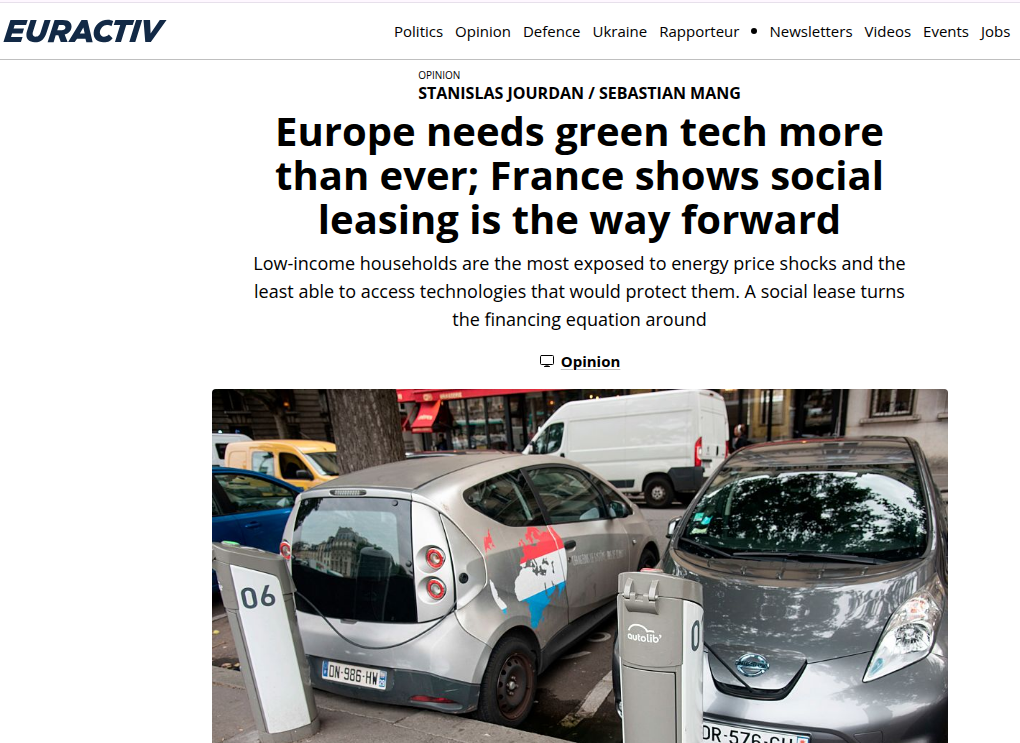
In 2023, France launched a social leasing scheme offering electric vehicles to low- and middle-income households for only €49-150 a month. The economics are straightforward: the state subsidises the upfront cost, removing the main barrier to adoption. Since EVs are cheaper to run than petrol and diesel cars, customers save on overall monthly expenses. 

France’s scheme includes several safeguards. Eligibility is targeted at low- and middle-income households who depend on their car for work. Monthly lease payments are capped, and environmental standards effectively exclude SUVs.  

Unsurprisingly, 55% of applicants were from rural areas – precisely the people most exposed to fuel price increases and generally more sceptical that the transition would deliver for them. 

The programme cost €370 million a year. Just last week, the government announced its ambition to double the programme size to 100,000 vehicles, with priority to the most car-dependent workers, such as homecare nurses.  

The potential for scaling up this model at EU level is immense. Analysis shows that by allocating just half of the €86.7 billion Social Climate Fund to social leasing, the EU could fund over 8.6 million EV contracts across the continent, replacing nearly 10% of the EU’s total car fleet. 

The return to households from the EU’s investment could be amplified by negotiating bulk-purchase discounts from manufacturers. We have already seen this happen in the UK’s Motability scheme, which has delivered around a 45% reduction in the net cost of car ownership. 

But the potential goes beyond electric vehicles. The upfront cost is also the main barrier preventing low- and middle-income households from accessing solar panels, home batteries and heat pumps. A social leasing programme spanning all four would allow governments to drive down fossil fuel demand in transport, heating and power simultaneously.

New electric vehicles are realistically accessible only to the wealthiest 30% of households in France. Heat pumps cost between €8,000 and €10,000 even after subsidies, while only the top fifth of households can fund deep renovations from savings. Clean tech, and the cost savings associated, are currently a product for the wealthy.

Social leasing could become a key component to reconcile an ambitious Europe’s industrial policy with the promise of a fair transition for all. Local content requirements would turn household adoption into a manufacturing stimulus. Heat pumps are already 73% European-made. European factories already have the capacity to produce twice as many electric vehicles as the current domestic demand, but lack reliable demand. A social leasing programme would provide exactly that.

Low- and middle-income households are the most exposed to energy price shocks and the least able to access the technologies that would protect them. A social lease turns the financing equation around, bringing the benefits of clean technologies upfront, while smoothing out the financial cost over time.

France’s experience shows there is enormous demand for exactly this. When the scheme launched, it was oversubscribed in six weeks. A European programme built on the same logic would not only be popular, but also one of the most tangible things Brussels has done for household budgets, while providing a real sense that the energy transition – and the EU – are working in their favour. 

Categories
Analysis and views op-eds

The ECB needs political guidance on secondary objectives

The ECB’s mandate was established three decades ago, when none of the current challenges were foreseen. It is therefore only natural that the ECB’s mandate today is subject to different and sometimes contradicting interpretations across the euro area. While the European Court of Justice has a role to play in identifying safeguards and limits to ensure that the ECB respects the boundaries set by the EU Treaties, it should not decide in the place of elected policymakers on the future orientations of the ECB’s mandate.

This opinion was originally published in Le MondeO Jornal EconómicoMakronomEuractivDe TijdIl Sole 24 OreNRC Handelsblad and El Economista on 22 April 2021.

The ECB is facing a paradox. On the one hand, the ECB has failed to achieve its price stability mandate, as inflation has been below 2% for the past decade. And despite this blatant failure, the ECB is now thinking about doing more than just looking after stable prices. For instance, Christine Lagarde has been raising expectations that the ECB will take concrete action against climate change when completing the ECB’s strategy review.

In theory, the European Treaties already confer large power to the ECB to act on other goals than its primary mandate of price stability. Article 127 TFEU stipulates that without prejudice to price stability, the ECB “shall support the general economic policies in the Union with a view to contributing to the achievement of the objectives of the Union as laid down in Article 3 of the Treaty on European Union.”

Over the years, this Treaty provision has often been mentioned by those who want to push the ECB to act  in various directions. Typically, trade unions want the ECB to pursue  full-employment more forcefully, while NGOs wish the ECB would do more to fight climate change or inequality. As a matter of fact, the breadth of objectives mentioned in Article 3 of the TEU – ranging from security, equity and economic growth to environmental protection, innovation and many other laudable EU objectives – opens the door to an infinite number of possible objectives for the ECB.

To some extent, such flexibility is useful and convenient. It leaves the door open to all possible winds of changes. But at the end of the day, too much vagueness is also leading to inaction. Indeed, by cutting through the vagueness and explicitly justifying its monetary policy stance based on a secondary objective, the ECB would be perceived as making political decisions, and hence prefers to stay away from that.

The ECB suffers from “democratic authorization gaps”

The neglect of the secondary objectives is understandable when considering that the ECB mandate is blank on guidance on how these secondary objectives should be ranked and attained. The ECB suffers from “democratic authorisation gaps”, i.e. the drafters’ failure to foresee the situations the ECB currently finds itself in: having to decide between different goals and tools that all have far-reaching consequences beyond what the Treaty writers anticipated.

While the ordering is clear between the ECB’s primary price-stability mandate and its supervisory duties, whether and how the ECB should act on its secondary objectives is much more blurred and subject to difficult trade-offs. Should the ECB favour jobs or climate? Sometimes using different tools to achieve different objectives could be possible but sometimes it is not the case. Dealing with such trade-offs is inherently a political task and the ECB should welcome some explicit guidance on which secondary objectives are the most relevant for the EU in a particular situation. As former ECB Board member Benoit Cœuré once said: “Setting priorities between different objectives is the definition of policy […] and that is what parliaments do”.

This is why, to add legitimacy for the ECB acting on its secondary objectives, a formal procedure involving both the Council and the European Parliament should be developed in order to specify and prioritise the policy areas where the ECB would be expected to deliver.

In practice, the existing channels of accountability between the European Parliament and the ECB already provide a conduit for such prioritisation. The Parliament could use its annual resolutions on the ECB to vote a ranking of three top secondary objectives, and could choose to refocus the quarterly “monetary dialogues” hearings with the ECB President to carry out regular checks on the delivery of the thus-interpreted mandate.

In this manner, the ECB would receive renewed legitimacy for an expanded set of goals. It could work efficiently, deploying its full toolkit towards a clear and politically defined set of policy objectives, guided by democratic institutions.

The ECB’s mandate was established three decades ago, when none of the current challenges were foreseen. It is therefore only natural that the ECB’s mandate today is subject to different and sometimes contradicting interpretations across the euro area. While the European Court of Justice has a role to play in identifying safeguards and limits to ensure that the ECB respects the boundaries set by the EU Treaties, it should not decide in the place of elected policymakers on the future orientations of the ECB’s mandate.

The European Parliament has taken an important step in December 2020 by requesting to put in place an inter-institutional agreement on the ECB’s accountability framework – which to date is largely informal. The upcoming negotiations between the ECB and the Parliament, alongside the ongoing strategy review of the ECB, offer a unique opportunity to enhance a strong accountability process directly with the ECB, in full respect of its independence.

Signatories: Grégory Claeys, Senior Fellow at Bruegel; Pervenche Berès, former chair of the European Parliament’s Economic and monetary affairs committee; Nik de Boer, an assistant professor in constitutional law at the University of Amsterdam; Panicos Demetriades, professor at Leicester University and former member of the ECB’s Governing Council; Sebastian Diessner, Fellow at the European University Institute; Stanislas Jourdan, executive director of Positive Money Europe; Jens van‘t Klooster, postdoctoral Fellow at KU Leuven; Vivien Schmid, professor of European Integration at Boston University.