Categories
Analysis and views

Hiking Rates in an Energy Crisis: A Cure Worse Than the Disease?

Amid geopolitical tensions and elevated energy prices, central bankers face a difficult choice: tighten policy to crush energy-driven inflation, or hold steady to protect investments in the energy transition?

As the conflict in the middle east continues and with no sign of a possible appeasement, pressure will be mounting in the coming weeks on central banks to adjust their monetary policy course. The ECB’s governing council is meeting exactly today and this issue will obviously be on their minds.

This is a debate we had back in 2022: the “team transitory” position was that the ECB should not intervene, arguing that the post-COVID inflation would naturally subside. However, the shock of the war in Ukraine clarified that the inflationary impact from the disruption in gas markets would be much greater than initially anticipated.

Already yesterday Chris Giles argued in the Financial Times that central banks must actively prevent persistent inflation and wage-price spirals, stemming from higher fuel prices, through a credible commitment to policy tightening.

While major ECB decisions are unlikely this week, I hope the lessons of 2022-2023 are learned. As a modest attempt to contribute to this debate, I will review in this article some of the recent literature on the implications of energy price shocks for monetary policy implementation.

Yes, central banks can actually lower energy prices

Contrary to what I thought a few years ago, monetary policy tightening, if frontloaded, can effectively help lower prices. Gökhan Ider , Alexander Kriwoluzky , Frederik Kurcz and Ben Schumann (2024) demonstrate that the optimal mandate-achieving policy involves a front-loaded tightening, particularly at the longer end of the yield curve, which quickly depresses global energy prices and stabilizes inflation expectations without inducing a severe recession.

BUT…

However while their analytical conclusion might be correct, many economists would disagree with the policy prescription. For instance Veronica Guerrieri, Michala Marcussen , Lucrezia Reichlin and Silvana Tenreyro (2023) have argued for patience. They show that energy supply shocks affect sectors asymmetrically, requiring temporary higher inflation to facilitate efficient resource reallocation and relative price adjustments.

Adding to this perspective, Gregor Boehl, Flora Budianto, and Előd Takáts (2024) show in this BIS paper that a monetary policy with less emphasis on strict inflation stabilization actually accelerates the green transition, as temporarily higher inflation and energy prices boost clean innovation. In the same vein, David Barmes , Irene Claeys, Simon Dikau and Luiz Awazu Pereira da Silva (2024) advocate for an “adaptive inflation targeting” framework.

Going further Luca Fornaro , Veronica Guerrieri, and Lucrezia Reichlin (2025) have acutely explained how the central bank’s “reaction function” is fundamentally complicated by the “green dilemma” : hiking rates during an energy crisis may help tame inflation on the short-run, but could structurally damage the long-term green transition. In particular, higher cost of capital is particularly harmful for investments in the green technologies that we actually need to get rid of our fossil fuel dependencies and make the economy more resilient against the very type of shocks that we are seeing today.

This hypothesis is empirically confirmed by Alexandra Serebriakova, Friedemann Polzin and Mark Sanders (2026). In a very recent paper published in Energy Economics, they find that over 2001–2024, every 25 basis point increase in policy rates by the ECB have reduced installed capacity for onshore wind by 3.2 percent and solar photovoltaic by 5.3 percent, equivalent to a decrease in renewables energy by 0.16% in the EU’s energy mix.

A complementary study by Daniel Navia Simon, and Laura Diaz Anadon (2025) projects that if member states achieve their climate and energy plans by 2030, the overall EU electricity price would fall by at least 26%. However the literature is very nuanced as to what extend cheaper renewable energy generation may translate into lower HICP inflation. For instance, in this IMF working paper, Laurent Millischer, Chenxu Fy, Ulrich Volz and John Beirne (2024) find no correlation, while Łukasz Markowski and Kamil Kotliński (2023) find a small one (1pp additional renewable lead to -0.13% inflation).

So what?

Finding the optimal monetary policy response in a context of energy price shocks is a complex issue. As I have extensively written elsewhere, I have a personal preference for the introduction of differentiated interest rates (see my WWF report here) as a solution to the green dilemma: if it needed to, the ECB could raise its key interest rates, while maintaining lower rates under refinancing operations targeted at specific loans for renewables and energy efficiency .

But leaving such innovative policy option aside, a more general implication of the recent literature is that the discussion must extend beyond simply how the ECB can best achieve 2% inflation in the medium term. Central banks must also consider the costs involved for society and the expected outcome on the economy after the crisis is gone.

Just like Trump should not have made reckless moves to attack Iran without a clear endgame in mind, central banks should avoid hastily raising rates in the short term if they can predictably see how the economy would be more vulnerable and less competitive as a result.
Categories
Analysis and views

Why Europe Must Rethink Central Bank Independence 

From the US to Turkey and the EU, the populist right has sought to capture central banks for partisan ends. While defending the independence of central banks from this attack is essential for economic stability and the rule of law, it must not mean endorsing their failures. Stronger accountability and clearer coordination between monetary and fiscal policy are key to reconciling central bank independence with democratic goals such as climate resilience and economic justice.  

Trump’s failed attempt to remove Lisa Cook, the first Black woman ever appointed to the Board of Governors of the Federal Reserve (Fed), is part of a broader plan to bring the US’s central bank to heel and dismantle the rule of law. By stacking the board with loyalists, Trump aims to bend monetary policy to his will, cutting rates to finance tax breaks for the wealthy and to try and manufacture short-term growth, rather than safeguarding long-term economic stability. This is not about better economic management, but about weaponising the central banks to serve partisan ends while sidelining society’s real challenges: inequality, inflation, instability, and the climate crisis. 

The reality is that Trump’s agenda would weaken, not strengthen, the US economy. A politicised Fed is likely to dismiss the real causes of price instability, and instead become a source of instability itself. Since the dollar underpins global finance, a loss of confidence in the Fed could destabilise US Treasuries and spike global borrowing costs at a time when predictable financing is critical for competitiveness and the green transition. 

Trump’s attempt to subordinate the Fed is part of a global trend. Turkey’s Erdoğan has repeatedly fired central bank governors who hiked interest rates; Modi has overridden decisions by the Central Bank of India in an effort to bring it under tighter government control; Nigel Farage’s Reform UK has railed against central banks buying bonds (a practice known as quantitative easing), as has Germany’s AfD, accusing the European Central Bank of stoking inflation. Ironically, French National Rally’s Jordan Bardella wants the ECB to do exactly the opposite: buy bonds to relieve France’s public debt situation. Their goal is not only to weaken technocratic authority but to capture monetary power as a political tool.  

Defending central bank independence against capture by the populist right is essential to upholding the rule of law and separation of powers, as well as keeping inflation in check. But protecting independence cannot mean defending the current technocratic orthodoxy that has too often failed society.  

Price stability at what cost? 

For decades, central bank independence has been sold as a guarantee of stability. But while the ECB has recently declared victory over inflation, the reality is far less flattering.  

recent paper by the International Monetary Fund (IMF) shows that, in 2022-2023, inflation-targeting central banks (those that, like the ECB, focus on keeping prices within a narrow range) performed no better in curbing inflation than central banks guided by broader mandates that also consider growth, employment, and financial stability. Other studies show that central banks in general tend to overstate the efficacy of monetary policy in controlling inflation.  

The biggest reason for such failure is likely that the central banking orthodoxy misunderstood the source of inflation and applied the wrong cure. Central banks acted as if inflation was driven by demand-led pressure, when it was in fact predominantly caused by a “cost-push” – namely, skyrocketing global fossil fuel energy prices. 

Moreover, as Isabella Weber and other economists have argued, the price surge of 2022-2023 was made worse by “greedflation”, where dominant firms raised prices to protect or expand their profit margins. Meanwhile, empirical research found that, in the US, roughly half of the excess fossil-fuel profits went to the wealthiest 1 per cent of households, while the bottom half received less than 1 per cent. Other research by Weber and colleagues empirically demonstrated that rate hikes (the recipe central banks typically use to curb inflation) cannot break greedflation, because firms simply pass higher financing costs on to consumers.  

Worse still, the ECB’s policies have not only been ineffective against inflation – they’ve been counterproductive for the green transition. New empirical evidence suggests that every time the ECB raises rates by 0.25 per cent, it reduces new offshore wind installations by 8 per cent and solar photovoltaic installations by 26.5 per cent, due to higher capital cost for these investments 

The ECB’s policies have not only been ineffective against inflation – they’ve been counterproductive for the green transition.

And as economists Luca Fornaro, Lucrezia Reichlin and Veronica Guerrieri warn, the ECB’s short-term focus on price stability could undermine its own long-term goals of price stability. Even if inflation is stable for now, climate disruption will make supply shocks more frequent. ECB researchers estimate that by 2035, depending on the level of global warming, headline inflation could increase by 0.3-1.2 per cent a year on average, while food prices could rise by 0.9-3.2 per cent a year. As climate damages intensify, dealing with supply shocks will only grow more complex.  

Add it all together, and it’s clear that the current monetary policy framework has not only failed to keep inflation in check but is increasingly ill-equipped for the world we inhabit.  

More coordination, not less independence 

The challenge is to preserve the ECB’s credibility and autonomy while aligning monetary policy with long-term goals like competitiveness, affordability, and climate resilience. 

Such a strategy should start by recognising that, contrary to central banking textbooks, inflation is not always a monetary problem. It can stem from multifaceted phenomena such as geopolitical shocks, supply bottlenecks, climate events, or corporate profiteering. In such a complex and uncertain world, one single instrument – interest rate – cannot solve it all. By contrast, a combination of instruments deployed by both central banks and governments could be more effective in achieving price stability.  

Inflation is not always a monetary problem. It can stem from multifaceted phenomena such as geopolitical shocks, supply bottlenecks, climate events, or corporate profiteering.

Such coordination could be implemented within the existing legal framework. The ECB’s legal mandate already allows it to support EU economic policies as long as they do not prejudice price stability. However, this secondary mandate is poorly defined and therefore often neglected. For example, should the ECB provide lower interest rates or more lenient collateral rules for renewable energy businesses and affordable social housing? Or should it instead support labour-intensive manufacturing industries? These are deeply political questions that unelected central bankers lack the democratic legitimacy to decide on. 

As multiple academics and policymakers have argued in recent years, central bankers shouldn’t have to make such consequential choices alone. In line with the Maastricht Treaty’s concept of the “broad guidelines” on economic policies, EU member states, together with the European Commission and the Parliament, should jointly define a small number of time-bound secondary objectives that reinforce price stability, such as cutting reliance on imported fossil fuels or boosting investments in affordable housing. 

Accountability mechanisms should be reinforced, so the ECB can justify its decisions in a transparent way, including when it declines to pursue certain secondary objectives. To that end, Professor Eric Monnet and the New Economics Foundation proposed the creation of a coordination council at the EU level. Bringing together finance ministries, the ECB, EU institutions, and competition authorities, such a council would offer a permanent forum to agree on shared objectives and keep potential misalignments in check. 

This approach strengthens the coordination between fiscal policy (primarily a responsibility of EU member states) and monetary policy (part of the ECB’s mandate). Crucially, a whole-of-government approach to macroeconomics enables to focus on tackling the actual origins of the inflationary pressure by encouraging policymakers to deploy the optimal combination of policy instruments.  

During supply-driven inflation, governments should invest to ease real shortages or implement price caps on basic goods, including to limit the spread of inflation to other sectors. In the presence of greedflation, solutions like rent controls, price caps, windfall taxes, and anti-monopoly action could be appropriate. Greater coordination would give governments stronger incentives to implement these inflation-repressing policies because these measures, if successful, would reduce the need for interest rate hikes, shielding governments from higher debt costs.  

Coordination would also allow policymakers to better prepare for and mitigate future price instability risks. For example, an obvious strategy to pre-empt future energy price shocks is to increase investments in renewable energy generation, storage, and grid interconnections, as well as in energy efficiency, given the disinflationary impact of these investments. Accompanying this strategy with the implementation of a “green interest rate” policy by the ECB would help ensure low and stable financing costs for these investments. 

Serving the people 

The populist right’s path of chaos and capture offers a false solution to a very real problem: a status quo of increasingly impotent central banks in the face of ever more complex challenges. However, there is a different course we could chart for central banking: one that protects their credibility and autonomy while aligning monetary policy more closely with democratically defined goals. 

For the EU, this shift doesn’t require treaty changes, but a new mindset. The ECB has adapted before: Mario Draghi’s “whatever it takes” saved the euro during the European sovereign debt crisis, and his successor, the current ECB President Christine Lagarde, has courageously brought climate change into central bankers’ minds. The question now is whether politicians in Brussels and Frankfurt can rise to the new challenge. If not, they risk reinforcing the feeling that central banks serve elites, not the people. 

Categories
Publication

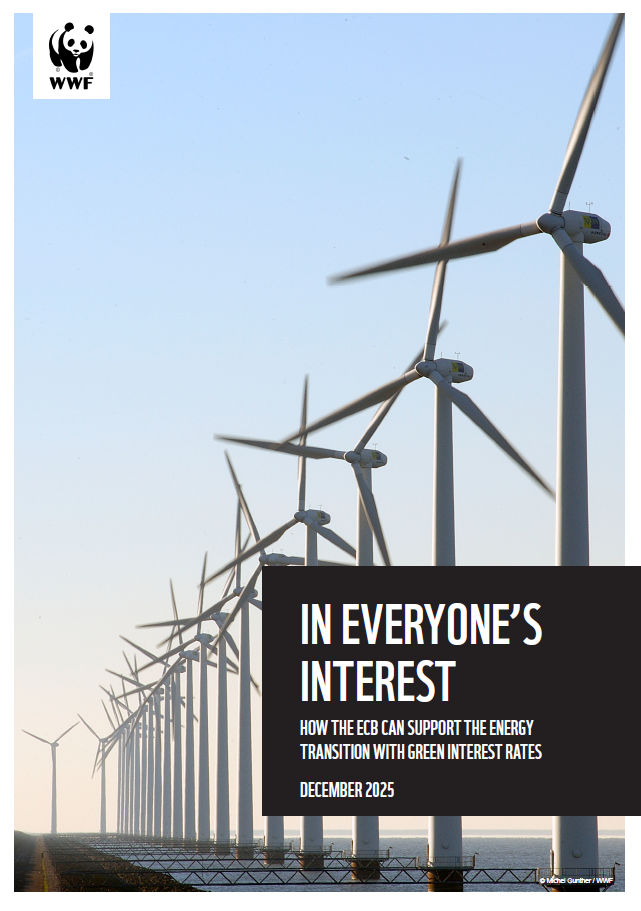
In everyone’s interest

This study investigates the feasibility, design, and macroeconomic implications of introducing a green interest rate into the European Central Bank’s (ECB) monetary policy framework. Building on recent advancements in green finance taxonomy and regulatory disclosure, the report argues that preferential interest rates for loans financing taxonomyaligned green investments would be legally and operationally viable in the ECB’s forthcoming operational framework, subject to adequate safeguards and policy calibration. Using bank-level data from 47 EU banks, the study estimates that at least €10 billion in eligible green lending could be supported each year. The analysis demonstrates that targeted support for investments in energy efficiency, renewables, energy grid, and sustainable transport can reduce Europe’s vulnerability to energy price shocks, with potential disinflationary effects in the medium term.

Recommended citation:

Jourdan, Stanislas (2025) In everyone’s interest: How the ECB can  support the energy transition with green interest rates. WWF-EU. Available at: https://wwfeu.awsassets.panda.org/downloads/in-everyones-interest-december-2025.pdf.
Categories
Publication

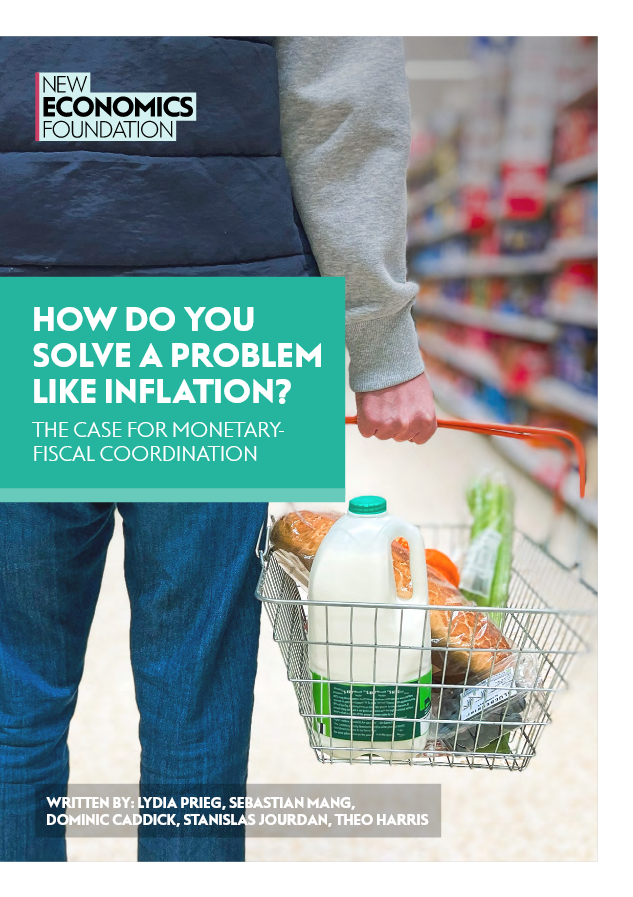
How do you solve a problem like inflation?

In this new report published by the New Economics Foundation (NEF), we argue that the traditional, strict separation between independent monetary policy and democratically set fiscal policy is insufficient for addressing the complex, overlapping crises of the 21st century. While central banks have historically focused almost exclusively on price stability through interest rate adjustments, the authors contend that intentional monetary-fiscal coordination is essential to tackle modern challenges like supply-side shocks, climate change, and persistent economic stagnation.

Recommended citation:

Prieg, L., Mang, S., Caddick, D., Jourdan, S. and Harris, T. (2025) How do you solve a problem like inflation? The case for monetary-fiscal coordination. New Economics Foundation. Available at: https://neweconomics.org/uploads/files/how-do-you-solve-a-problem-like-inflation.pdf.

Categories
Publication

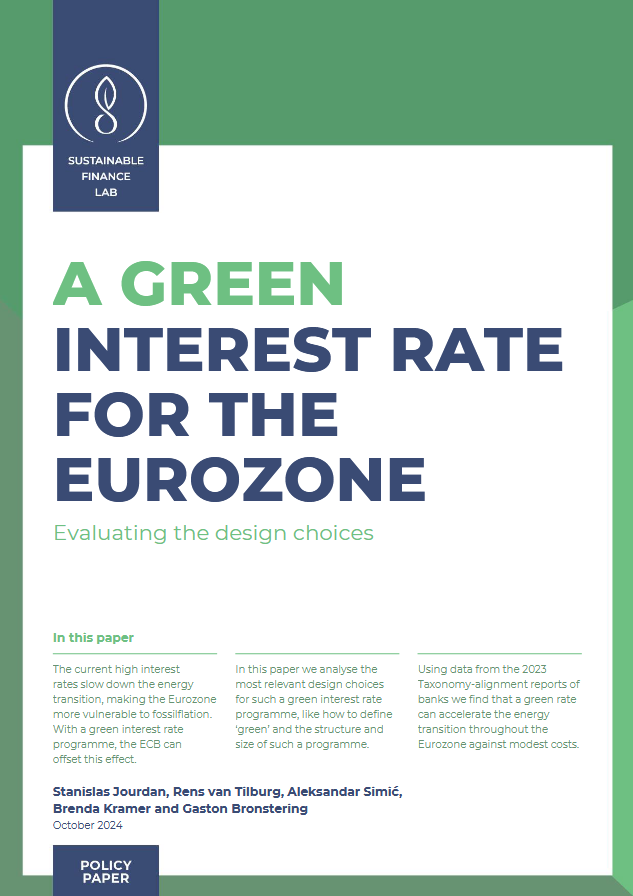
A green interest rate for the Eurozone

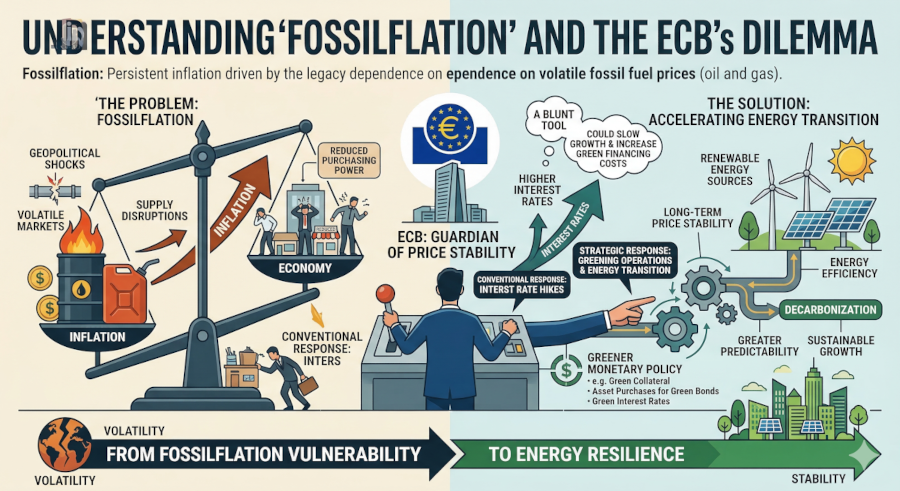
The current high interest rates slow down the energy transition, making the Eurozone more vulnerable to fossilflation. With a green interest rate programme, the ECB can offset this effect. In this paper we analyse the most relevant design choices for such a green interest rate programme, like how to define ‘green’ and the structure and size of such a programme. Using data from the 2023 Taxonomy-alignment reports of banks we find that a green rate can accelerate the energy transition throughout the Eurozone against modest costs.

Recommended citation:

Jourdan, S., Van Tilburg, R., Kramer, B., Simić, A. and Bronstering, G. (2024) A green interest rate for the Eurozone: evaluating the design choices. Sustainable Finance Lab. Available at: https://papers.ssrn.com/sol3/papers.cfm?abstract_id=5015926.
Categories
Analysis and views

The ECB needs political guidance on secondary objectives

The ECB’s mandate was established three decades ago, when none of the current challenges were foreseen. It is therefore only natural that the ECB’s mandate today is subject to different and sometimes contradicting interpretations across the euro area. While the European Court of Justice has a role to play in identifying safeguards and limits to ensure that the ECB respects the boundaries set by the EU Treaties, it should not decide in the place of elected policymakers on the future orientations of the ECB’s mandate.

This opinion was originally published in Le MondeO Jornal EconómicoMakronomEuractivDe TijdIl Sole 24 OreNRC Handelsblad and El Economista on 22 April 2021.

The ECB is facing a paradox. On the one hand, the ECB has failed to achieve its price stability mandate, as inflation has been below 2% for the past decade. And despite this blatant failure, the ECB is now thinking about doing more than just looking after stable prices. For instance, Christine Lagarde has been raising expectations that the ECB will take concrete action against climate change when completing the ECB’s strategy review.

In theory, the European Treaties already confer large power to the ECB to act on other goals than its primary mandate of price stability. Article 127 TFEU stipulates that without prejudice to price stability, the ECB “shall support the general economic policies in the Union with a view to contributing to the achievement of the objectives of the Union as laid down in Article 3 of the Treaty on European Union.”

Over the years, this Treaty provision has often been mentioned by those who want to push the ECB to act  in various directions. Typically, trade unions want the ECB to pursue  full-employment more forcefully, while NGOs wish the ECB would do more to fight climate change or inequality. As a matter of fact, the breadth of objectives mentioned in Article 3 of the TEU – ranging from security, equity and economic growth to environmental protection, innovation and many other laudable EU objectives – opens the door to an infinite number of possible objectives for the ECB.

To some extent, such flexibility is useful and convenient. It leaves the door open to all possible winds of changes. But at the end of the day, too much vagueness is also leading to inaction. Indeed, by cutting through the vagueness and explicitly justifying its monetary policy stance based on a secondary objective, the ECB would be perceived as making political decisions, and hence prefers to stay away from that.

The ECB suffers from “democratic authorization gaps”

The neglect of the secondary objectives is understandable when considering that the ECB mandate is blank on guidance on how these secondary objectives should be ranked and attained. The ECB suffers from “democratic authorisation gaps”, i.e. the drafters’ failure to foresee the situations the ECB currently finds itself in: having to decide between different goals and tools that all have far-reaching consequences beyond what the Treaty writers anticipated.

While the ordering is clear between the ECB’s primary price-stability mandate and its supervisory duties, whether and how the ECB should act on its secondary objectives is much more blurred and subject to difficult trade-offs. Should the ECB favour jobs or climate? Sometimes using different tools to achieve different objectives could be possible but sometimes it is not the case. Dealing with such trade-offs is inherently a political task and the ECB should welcome some explicit guidance on which secondary objectives are the most relevant for the EU in a particular situation. As former ECB Board member Benoit Cœuré once said: “Setting priorities between different objectives is the definition of policy […] and that is what parliaments do”.

This is why, to add legitimacy for the ECB acting on its secondary objectives, a formal procedure involving both the Council and the European Parliament should be developed in order to specify and prioritise the policy areas where the ECB would be expected to deliver.

In practice, the existing channels of accountability between the European Parliament and the ECB already provide a conduit for such prioritisation. The Parliament could use its annual resolutions on the ECB to vote a ranking of three top secondary objectives, and could choose to refocus the quarterly “monetary dialogues” hearings with the ECB President to carry out regular checks on the delivery of the thus-interpreted mandate.

In this manner, the ECB would receive renewed legitimacy for an expanded set of goals. It could work efficiently, deploying its full toolkit towards a clear and politically defined set of policy objectives, guided by democratic institutions.

The ECB’s mandate was established three decades ago, when none of the current challenges were foreseen. It is therefore only natural that the ECB’s mandate today is subject to different and sometimes contradicting interpretations across the euro area. While the European Court of Justice has a role to play in identifying safeguards and limits to ensure that the ECB respects the boundaries set by the EU Treaties, it should not decide in the place of elected policymakers on the future orientations of the ECB’s mandate.

The European Parliament has taken an important step in December 2020 by requesting to put in place an inter-institutional agreement on the ECB’s accountability framework – which to date is largely informal. The upcoming negotiations between the ECB and the Parliament, alongside the ongoing strategy review of the ECB, offer a unique opportunity to enhance a strong accountability process directly with the ECB, in full respect of its independence.

Signatories: Grégory Claeys, Senior Fellow at Bruegel; Pervenche Berès, former chair of the European Parliament’s Economic and monetary affairs committee; Nik de Boer, an assistant professor in constitutional law at the University of Amsterdam; Panicos Demetriades, professor at Leicester University and former member of the ECB’s Governing Council; Sebastian Diessner, Fellow at the European University Institute; Stanislas Jourdan, executive director of Positive Money Europe; Jens van‘t Klooster, postdoctoral Fellow at KU Leuven; Vivien Schmid, professor of European Integration at Boston University.

Categories
Analysis and views

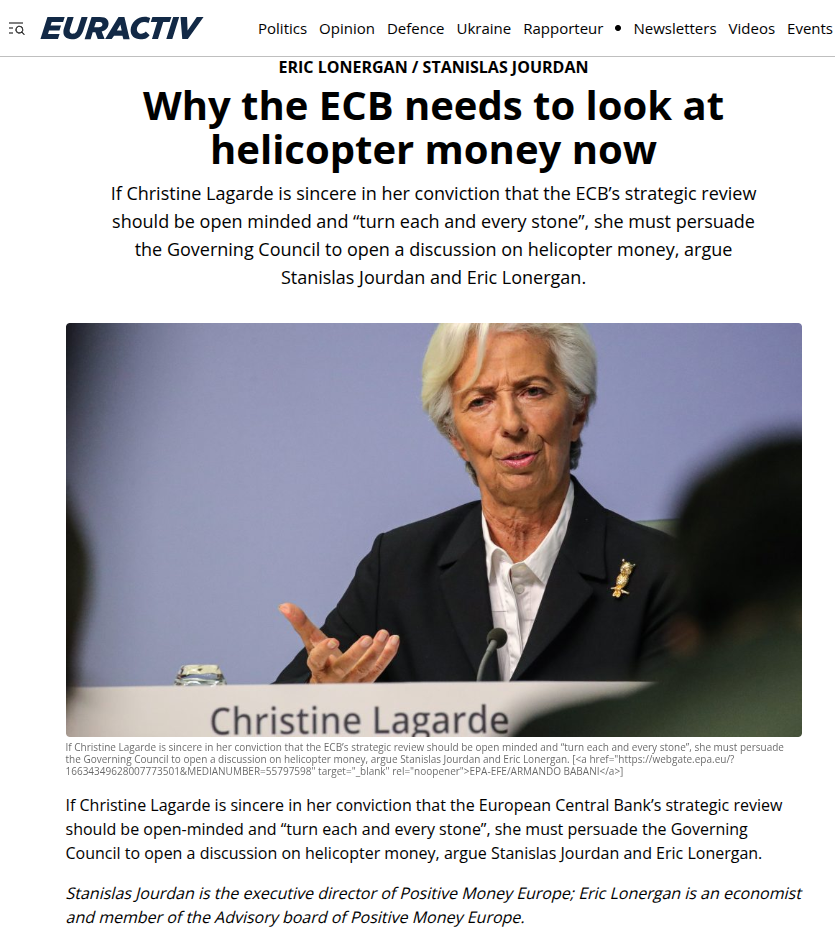
Why the ECB needs to look at helicopter money now

If Christine Lagarde is sincere in her conviction that the European Central Bank’s strategic review should be open-minded and “turn each and every stone”, she must seek to clarify the conditions under which it would be appropriate to activate helicopter money, while consulting with other EU institutions to specify the governance framework which would be needed to manage its distributional effects.

This op-ed was initially published in Euractiv.com on 6 February 2020, co-signed with Eric Lonergan.

Last Thursday, the Governing Council of the European Central Bank announced the official launch of its review of its monetary policy framework.

Having failed to maintain inflation close to its 2% target for the past six consecutive years, such a review is a long-overdue exercise, which should allow the ECB to update its strategy to the new post-crisis challenges that the ECB is facing, including global uncertainty, the slow post-crisis recovery, technological developments and risks related to climate change.

The Governing Council will be guided by two principles: thorough analysis and open minds.

So far, most of the debate has been focusing on whether the ECB should redefine its inflation target, perhaps with a more flexible target and a stronger focus on core inflation. But while desirable, a redefinition of the ECB’s inflation target cannot restore the ECB’s credibility if it is not accompanied with an in-depth conversation about the instruments that the ECB could use to achieve its target.

Indeed, after having injected more than €2.6 trillion and pushed rates down into negative territory, there is a growing sentiment in policy circles that the ECB has exhausted its firepower. But has it, really?

As a guardian of the money creation process, it’s not like the ECB can run out of money. However, there is no need for the ECB to only transmit its policy through financial markets.

Indeed, while the ECB is famously prohibited from financing governments directly, nothing in EU law rules out the so-called ‘helicopter money’ idea whereby the ECB would directly transfer money to all citizens. Although helicopter money is not needed right now, it is time to have a serious look at it.

From a purely economic perspective, it is difficult to argue against helicopter money. Just like under budgetary policies, money transfers to citizens would, to a large extent, translate into consumption. With the equivalent 10% of QE, the ECB could transfer around €900 to all adult citizens in the Euro area.

If only 40% of this money is spent, the effect would likely be close to a 1% GDP boost. When a crisis hits, this would be a significant nudge to growth and confidence.

If helicopter money is certain to work, why has it not been done?

First, many are worried that such a policy would be a step too far for independent central banks, as it would blur the lines between monetary and fiscal policy.

As Mario Draghi rightly pointed out during his last testimony to the European Parliament “when you look at it closely, you realise that the task of distributing money to one subject or another subject is typically a fiscal task. It’s a government decision. It’s not the central bank’s decision. And you certainly wouldn’t want the central bank deciding who should receive the money.”

But this issue can easily be solved by setting out a clear institutional framework. For example, former central bankers Stanley Fischer and co-authors proposed last summer that helicopter money could be operationalized through a “standing emergency fiscal facility.”

Under such a framework, the central bank would decide “how much” stimulus is needed, while elected representatives could define “where to”. In this respect, the involvement of the European Parliament in the ECB’s review may prove useful to further design such an institutional arrangement.

In another contribution to this debate, Olivier Blanchard and Jean Pisani-Ferry argue that helicopter money is a distraction from the necessary revision of the Eurozone fiscal framework. “If there were to be a deep recession, it would most likely trigger the escape clauses in the fiscal rules, making helicopter money redundant”, they say.

It is true that a revision of the Eurozone fiscal framework would likely contribute to the ECB’s objectives. But however necessary, it is not guaranteed that more flexible fiscal rules – if ever agreed upon – would be enough to close the ECB’s inflation gap.

To maintain its credibility as an independent central bank, the ECB must be able to intervene in any circumstances. When the next crisis hits, if all the ECB has left in its toolkit is to call on fiscal policymakers to turbocharge their deficit spending, then the case for the ECB’s independence is of little relevance.

If Christine Lagarde is sincere in her promise to ensure that the ECB’s strategic review will be comprehensive and “turn each and every stone”, she must persuade the Governing Council to open the discussion on helicopter money.

By the end of its strategic review, the ECB should at the very least seek to clarify the conditions under which it would be appropriate to activate helicopter money, while consulting with other EU institutions to specify the governance framework which would be needed to manage its distributional effects.

Failure to do so will only maintain the ongoing ambiguity on the scope of the ECB’s powers, ultimately risking leaving the ECB with no other choice but to push ahead with even more unconventional monetary policy in the future while hoping the Court of Justice of the EU will – once again – pick up the pieces.

Fortunately, the upcoming strategic review offers an opportunity to do better than muddling through the next crisis as unprepared as the last one.

Categories
Publication

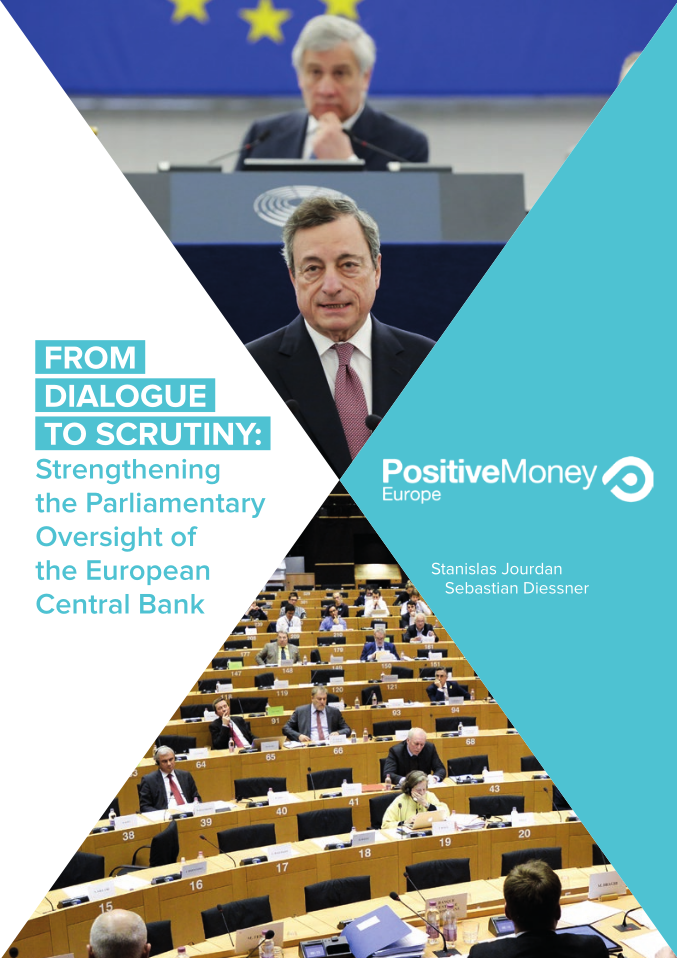
From Dialogue to Scrutiny

While the European Central Bank has gained significant new powers and competencies—including supervisory roles and unconventional monetary policy tools—following a decade of financial crisis, its formal accountability framework remains largely unchanged and reliant on informal arrangements. This report by Positive Money Europe proposes actionable reforms within the existing Treaty framework to align the ECB’s democratic legitimacy with its expanded influence.

Recommended citation:
Jourdan, S. and Diessner, S. (2019) From Dialogue to Scrutiny: Strengthening the Parliamentary oversight of the European Central Bank. Positive Money Europe. Available at: https://www.positivemoney.eu/wp-content/uploads/2019/04/2019_From-Dialogue-to-Scrutiny_PM_Web.pdf.