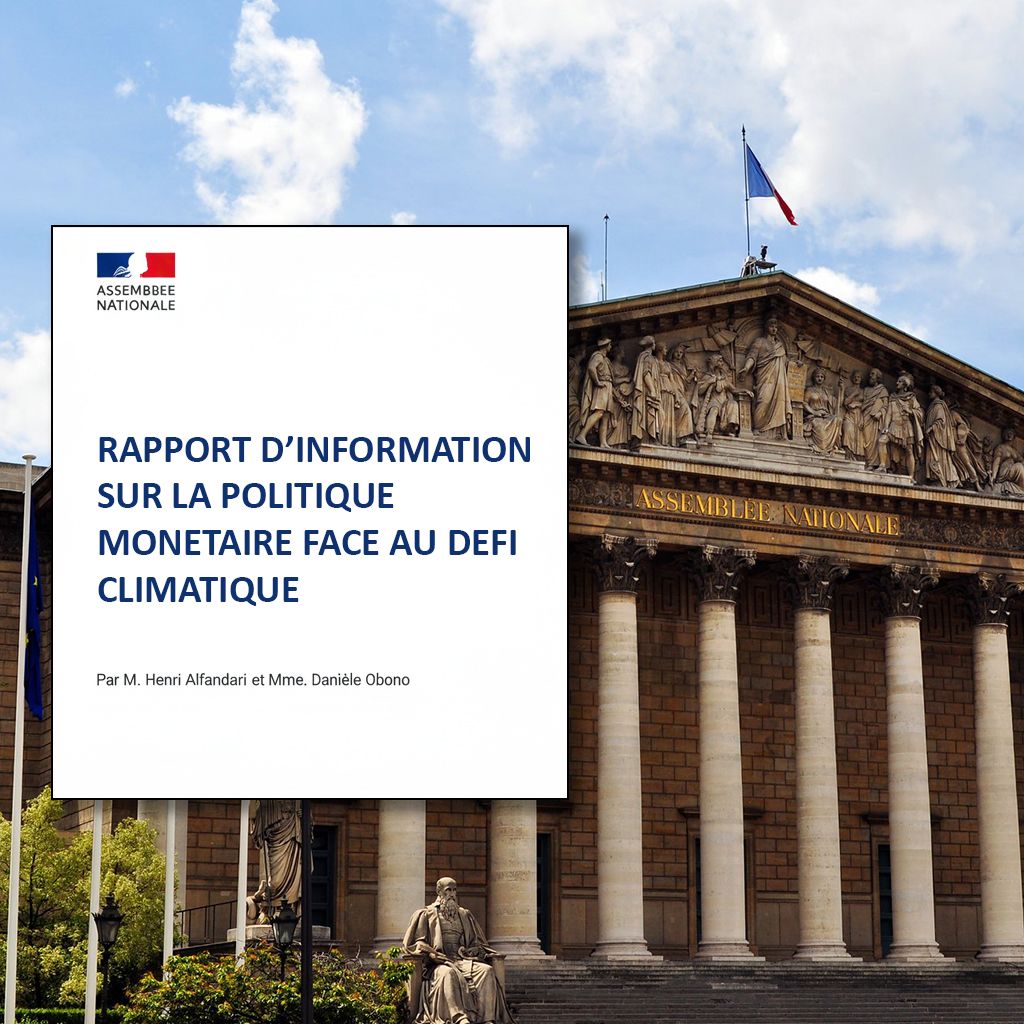
For the first time, a national parliament in the eurozone examines the role of the European Central bank. An exemplary precedent of unambiguous, transpartisan political support for the ECB and all Eurosystem central banks
This article was initially published as a blog post on the website of Finance Watch.
Last month, the European Affairs Committee of the French National Assembly published a landmark report on European Central Bank (ECB) monetary policy in the face of climate challenges. The report was produced in transpartisan collaboration between two members of Parliament: Henri Alfandari (Horizon, centrist) and Danièle Obono (La France Insoumise, far-left).
To date, this is the most detailed examination by a Eurozone national parliament on the role of central banks in addressing climate change. The analysis draws on the multiple contributions of the Finance Watch network.
Among the many recommendations, four stand out:
Tighter prudential rules
As advocated by Finance Watch and other organisations, the report recommends revising EU rules on capital requirements to explicitly account for climate risk. This recommendation specifically cites Finance Watch’s proposal to apply a 150% risk weight to fossil fuel exposures. Addressing the financial risks from stranded fossil fuel assets would strengthen banks’ resilience and facilitate an orderly transition. The latter is an essential precondition for financial stability, as recognised by prudential supervisors.
The inflation target debate
The report explores a controversial proposal: should the ECB raise the inflation target from 2% to 3%? Several economists, in particular from Bruegel (Reichlin and Zettelmeyer, 2024) or the CETEx (Barmes et al) argue that a more flexible approach to the European Central Bank’s inflation target could facilitate relative price adjustments during the green transition. The report notes, however, that the French Treasury and the Bank of France resist such a change, warning it could damage credibility and unanchor expectations. For this reason, the report does not formally endorse this proposal, leaving the debate unresolved.
Green interest rates could have “considerable impact”
The report examines the potential for a green interest rate policy by the European Central Bank. Drawing on the work of the Sustainable Finance Lab, WWF-EPO and Positive Money, the proposal would offer banks lower interest rates on refinancing operations, provided they reach green lending targets based on the European Taxonomy framework. Notably, the report highlights strong support for this tool from the French public investment bank Bpifrance. Their analysis, assuming a 50-basis-point reduction for green lending in a 3% interest rate environment, concluded that the policy could have a “considerable impact” on competitiveness.
Strengthening policy coordination
Crucially, the report calls for institutional reforms. To enhance democratic legitimacy, the report explicitly endorses creating a European Credit Council, a proposal advanced by Professor Eric Monnet, which would help advise the European Parliament on the economic and climate impacts of monetary policy. More broadly, the report calls for establishing enhanced coordination mechanisms between the ECB and other institutions, for example to clarify how the ECB formulates its secondary objectives in support of the EU’s general economic policies. The report stresses the importance of preventing the ECB from unilaterally defining the content of its secondary objectives.
In recent years, multiple experts and organisations have called on the EU to move in this direction. Notably, it was one of the recommendations of a recent report by the New Economics Foundation.
In conclusion, the report by Henri Alfandari and Danièle Obono demonstrates that central bank independence and democracy both benefit from strong parliamentary oversight.
Despite criticisms by various orthodox voices on the European Central Bank’s role on climate change, the report provides unambiguous, transpartisan political support for the ECB and all Eurosystem central banks, encouraging them to continue in this direction.